
He Didn’t Realise He’d Fallen

Stuart Holness, Guardian of the Hole, and why men need others to reach in
In 2012, Stuart Holness was 36.
By most standards, life was good.
He’d worked hard since he was 16.
Built a stable life.
Things were… fine.
Until they weren’t.
A couple of emotional experiences.
Becoming a victim of crime.
Nothing that screams “this will change everything.”
But it did.
What followed wasn’t dramatic.
No big moment.
No clear breakdown.
Just a gradual shift.
Stuart slipped into depression.
Lost direction.
Started surviving rather than living.
And like most men…
He carried it quietly.
Years passed like that.
Showing up.
Holding it together on the outside.
But internally?
Lost.
That’s the part people don’t see.
Because when people think about mental health, they look for crisis.
What Stuart experienced is what happens before that.
The slow fall.
The one you don’t even realise is happening.
That’s exactly what he captured in his book, Guardian of the Hole
Not as a clinical explanation.
As a story.
In the book, a man falls into a dark place.
Not suddenly.
Quietly.
“One day, without realising how, I found myself there…”
That line alone explains more than most reports ever will.

Above ground, life is light, colour, movement.
Below?
Heavy.
Silent.
Isolated.
“Days blurred together… thoughts grew heavy.”
And here’s where it gets uncomfortable.
He’s not alone.
He just thinks he is.
There’s a moment in the story that hits hard.
He asks why no one helped him.
And the response is:
“I did. Twice.”
That’s the reality for a lot of men.
Help is sometimes there.
But it’s not taken.
Because:
“I’ll deal with it.”
“I’ll get through it.”
“I don’t need help.”
Until they do.
Stuart lived that.
He hid his struggles from most people around him.
Not because he wanted to.
Because he didn’t know how to do anything else.
Eventually, he found support.
Not everywhere.
Not from everyone.
But from the right people.
People he felt safe with.
And that’s the difference.
Because men don’t open up where they should.
They open up where they can.
Then came lockdown.
Time to think.
Time to reflect.
Time to ask:
“What actually happened to me?”
Instead of more clinical language…
He wrote.
To understand it.
To process it.
To make sense of it in his own way.
When he shared it with a few people, something unexpected happened.
They saw themselves in it.
Not the exact story.
But the feeling.
That’s why this matters.
Because the story isn’t unique.
It’s familiar.
Back in the book, the turning point is simple.
He asks for help.
“I need help now.”
Not a speech.
Not a breakdown.
Just a moment.
And the way out?
It’s not strength alone.
It’s connection.
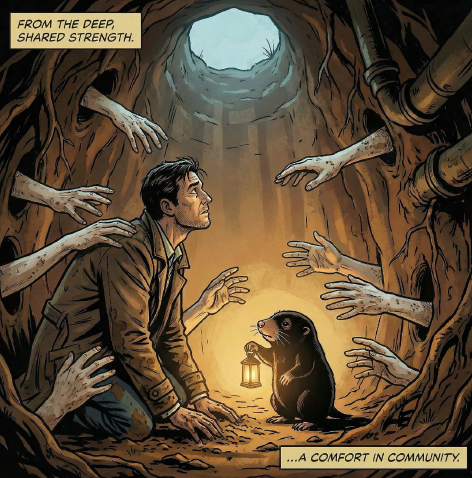
“Someone above will see it… and they will help you.”

Hands reach down.
Not because he shouted loud enough.
Because he reached.
When he gets back above ground, something changes.
He sees what he missed before.
“The hands. Some reaching, some trembling, some waiting to be noticed.”

That’s the message most people skip.
It’s not just about asking for help.
It’s about noticing others who aren’t asking.
At Tough To Talk, this is exactly where we work.
Because most men won’t:
• clearly say they’re struggling
• reach out early
• engage with support
Even if they want to.
So the responsibility shifts.
Not just onto men.
But onto the people and environments around them.
Stuart’s story doesn’t end with “he got better.”
It ends with something more important.
Responsibility.
“And now, I too can help.”
That’s the shift.
From:
“I need help”
to:
“I can see others who do”
The reality
We don’t need more messages telling men to reach out.
We need more men willing to reach in.
To notice changes.
To ask questions.
To stay when it’s uncomfortable.
Because most men won’t say it clearly.
But they’re hoping someone sees it.
Stuart says now:
“I feel lucky. I feel strong.”
But he also knows…
That’s today.
And it takes effort to stay there.
That honesty matters.
Because this isn’t about being fixed.
It’s about understanding what happened…
and making sure others don’t fall as far without someone noticing.
Final thought
Men don’t just fall.
They fall quietly.
And most of the time… they don’t climb out alone.
That’s where this work starts.
Get your copy here. Guardian of the Hole: Amazon.co.uk: Holness, Stuart, Marsden, Dan: 9798246603536: Books
Stuart Holness - Bio

Stuart Holness is the author of Guardian of the Hole, an illustrated story born from his own experience of trauma, depression and recovery.
In 2012, a combination of personal events and becoming a victim of crime led Stuart into a period of declining mental health, where he spent years feeling lost while continuing to function on the outside.
Through support from professionals he trusted, and time to reflect during lockdown, Stuart began to understand what had happened to him. He chose to write his story not in clinical terms, but in a way that others could feel and recognise.
Originally shared with a small circle, the response showed just how many people related to the experience. With the addition of illustrations by Dan Marsden, Guardian of the Hole became a powerful reflection on falling into dark places, asking for help, and the role others play in helping us back out.
Stuart’s aim is simple: if his story helps even one person feel less alone, it’s done its job.


Comments